


Collection of window functions for signal processing and spectral analysis.
npm install window-function
import { hann, kaiser, generate, apply } from 'window-function'

// Every window: fn(i, N, ...params) → number
hann(50, 101)                    // single sample → 1.0

// Generate full window as Float64Array
let w = generate(hann, 1024)

// Apply window to a signal in-place
let signal = new Float64Array(1024).fill(1)
apply(signal, hann)              // signal *= hann

// Parameterized windows pass extra args
generate(kaiser, 1024, 8.6)     // Kaiser with β = 8.6
Or import individual windows directly:
import hann from 'window-function/hann'
import kaiser from 'window-function/kaiser'
rectangular · triangular · bartlett · welch · connes · hann · hamming · cosine · blackman · exactBlackman · nuttall · blackmanNuttall · blackmanHarris · flatTop · bartlettHann · lanczos · parzen · bohman
kaiser · gaussian · generalizedNormal · tukey · planckTaper · powerOfSine · exponential · hannPoisson · cauchy · rifeVincent · confinedGaussian
dolphChebyshev · taylor · kaiserBesselDerived · dpss · ultraspherical
rectangular(i, N)$w(n) = 1$
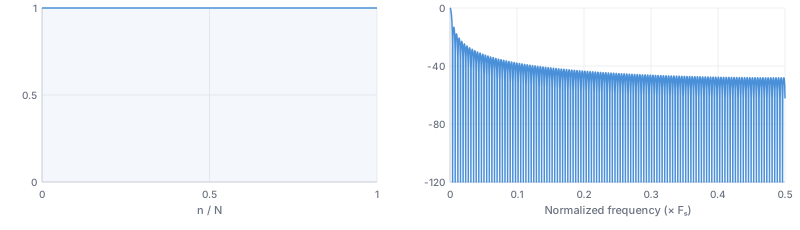
No windowing. Best frequency resolution, worst spectral leakage. Use for transient signals already zero at edges, or harmonic analysis with integer cycles. -13 dB sidelobe · -6 dB/oct rolloff
triangular(i, N)$w(n) = 1 - \left|\frac{2n - N + 1}{N}\right|$
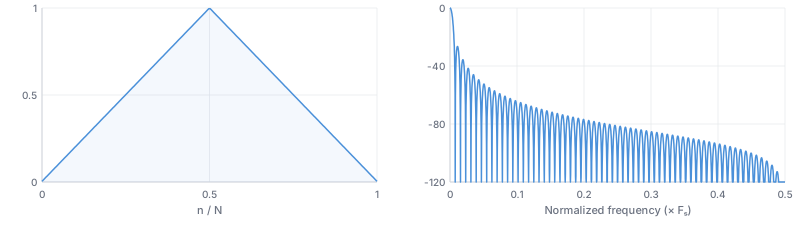
Linear taper, nonzero endpoints. Simple smoothing, 2nd-order B-spline. -27 dB sidelobe · -12 dB/oct rolloff
bartlett(i, N)$w(n) = 1 - \left|\frac{2n - N + 1}{N - 1}\right|$
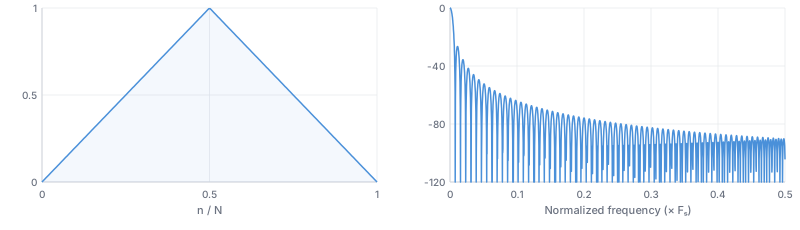
Linear taper, zero endpoints. Bartlett's method PSD estimation.1 -27 dB sidelobe · -12 dB/oct rolloff
welch(i, N)$w(n) = 1 - \left(\frac{2n - N + 1}{N - 1}\right)^2$
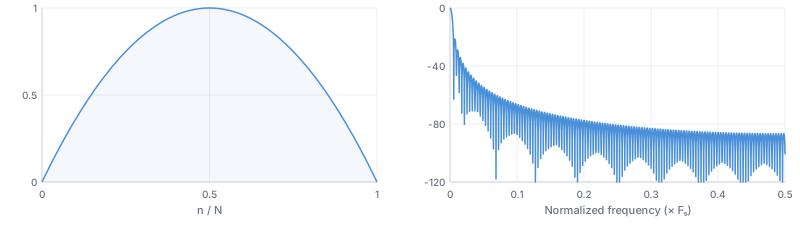
Parabolic taper. Welch's method PSD estimation.2 -21 dB sidelobe · -12 dB/oct rolloff
connes(i, N)$w(n) = \left[1 - \left(\frac{2n - N + 1}{N - 1}\right)^2\right]^2$
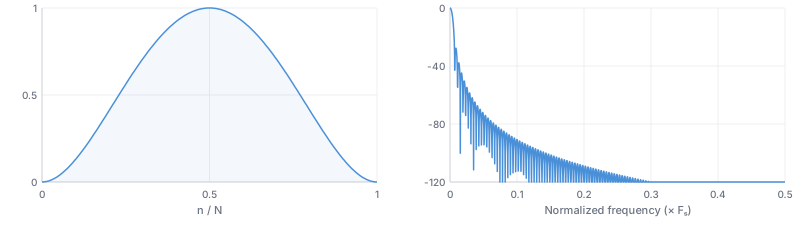
Welch squared (4th power parabolic). FTIR spectroscopy, interferogram apodization.3 -24 dB/oct rolloff
hann(i, N)$w(n) = 0.5 - 0.5\cos!\left(\frac{2\pi n}{N-1}\right)$
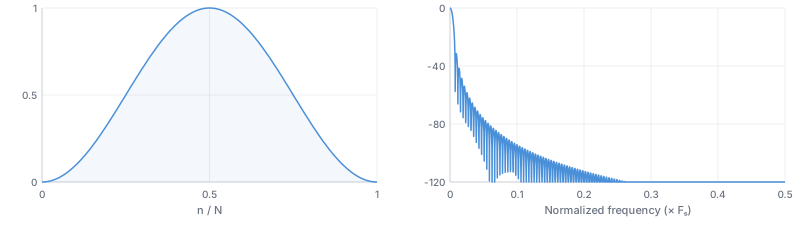
Raised cosine, zero endpoints. The default general-purpose choice. STFT with 50% overlap (COLA). Also called "Hanning" (misnomer).4 -32 dB sidelobe · -18 dB/oct rolloff
hamming(i, N)$w(n) = 0.54 - 0.46\cos!\left(\frac{2\pi n}{N-1}\right)$
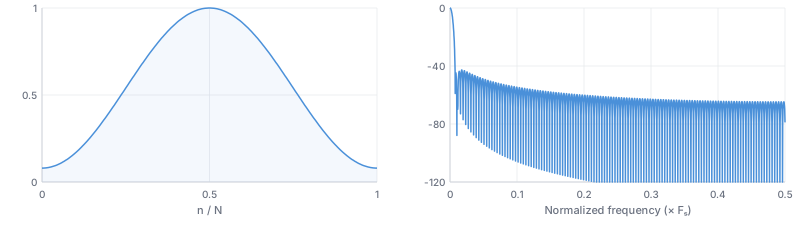
Raised cosine, nonzero endpoints. Optimized for first sidelobe cancellation. FIR filter design, speech processing.5 -43 dB sidelobe · -6 dB/oct rolloff
cosine(i, N)$w(n) = \sin!\left(\frac{\pi n}{N-1}\right)$
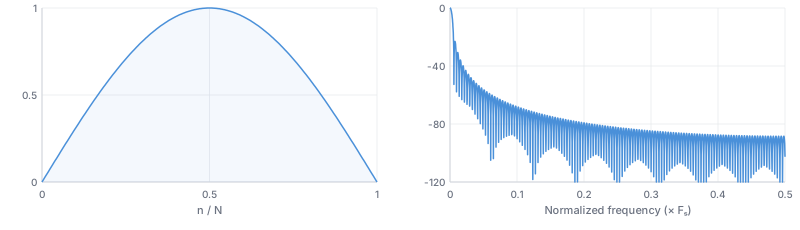
Half-period sine. MDCT audio codecs: MP3, AAC, Vorbis.6 -23 dB sidelobe · -12 dB/oct rolloff
blackman(i, N)$w(n) = 0.42 - 0.5\cos!\left(\frac{2\pi n}{N-1}\right) + 0.08\cos!\left(\frac{4\pi n}{N-1}\right)$
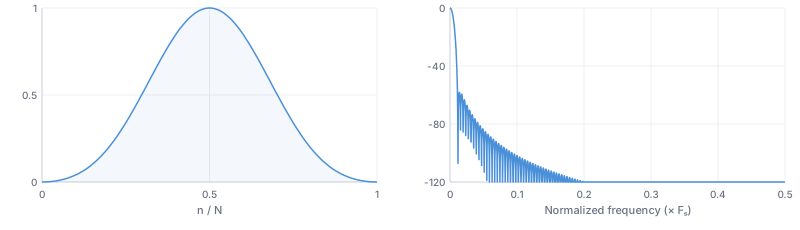
3-term cosine sum. Better leakage than Hann at the cost of wider main lobe.4 -58 dB sidelobe · -18 dB/oct rolloff
exactBlackman(i, N)$w(n) = 0.42659 - 0.49656\cos!\left(\frac{2\pi n}{N-1}\right) + 0.076849\cos!\left(\frac{4\pi n}{N-1}\right)$
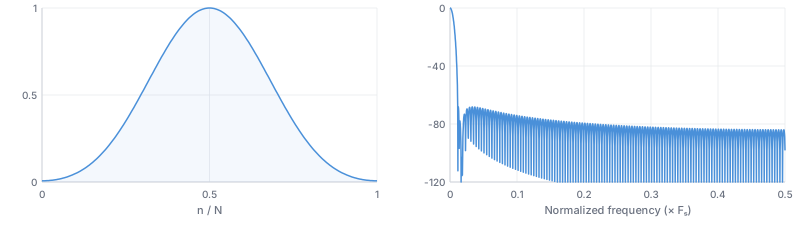
Blackman with exact zero placement at 3rd and 4th sidelobes.7 -69 dB sidelobe · -6 dB/oct rolloff
nuttall(i, N)$w(n) = 0.355768 - 0.487396\cos!\left(\frac{2\pi n}{N!-!1}\right) + 0.144232\cos!\left(\frac{4\pi n}{N!-!1}\right) - 0.012604\cos!\left(\frac{6\pi n}{N!-!1}\right)$
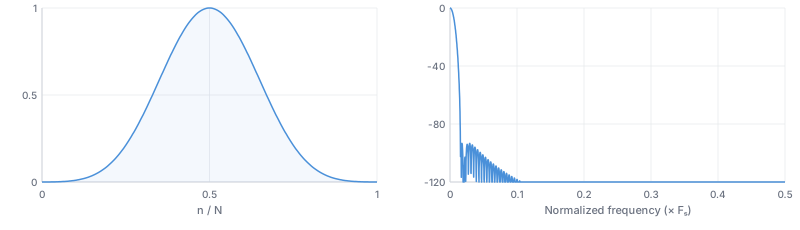
4-term cosine sum, continuous 1st derivative. High-dynamic-range analysis without edge discontinuity.8 -93 dB sidelobe · -18 dB/oct rolloff
blackmanNuttall(i, N)$w(n) = 0.3635819 - 0.4891775\cos!\left(\frac{2\pi n}{N!-!1}\right) + 0.1365995\cos!\left(\frac{4\pi n}{N!-!1}\right) - 0.0106411\cos!\left(\frac{6\pi n}{N!-!1}\right)$
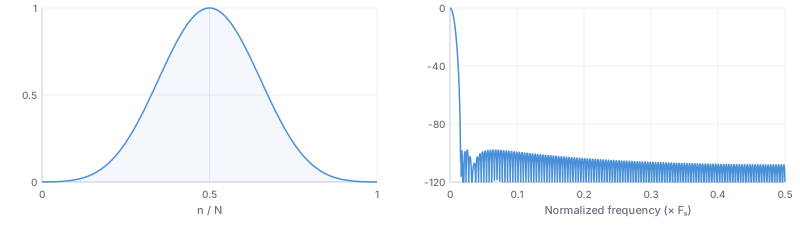
4-term cosine sum, lowest sidelobes among 4-term windows.8 -98 dB sidelobe · -6 dB/oct rolloff
blackmanHarris(i, N)$w(n) = 0.35875 - 0.48829\cos!\left(\frac{2\pi n}{N!-!1}\right) + 0.14128\cos!\left(\frac{4\pi n}{N!-!1}\right) - 0.01168\cos!\left(\frac{6\pi n}{N!-!1}\right)$
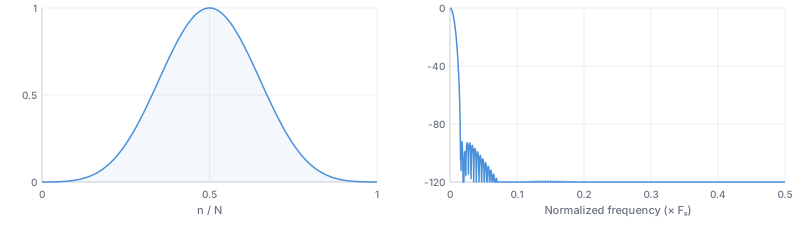
4-term minimum sidelobe. ADC testing, measurement instrumentation, >80 dB dynamic range.7 -92 dB sidelobe · -6 dB/oct rolloff
flatTop(i, N)$w(n) = 1 - 1.93\cos!\left(\frac{2\pi n}{N!-!1}\right) + 1.29\cos!\left(\frac{4\pi n}{N!-!1}\right) - 0.388\cos!\left(\frac{6\pi n}{N!-!1}\right) + 0.028\cos!\left(\frac{8\pi n}{N!-!1}\right)$
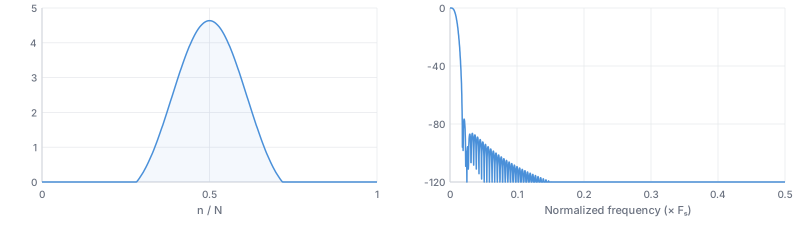
5-term cosine sum, near-zero scalloping. Peak ~4.64 (by design). Amplitude calibration, transducer calibration (~0.01 dB accuracy). ISO 18431.9 -93 dB sidelobe · -6 dB/oct rolloff
bartlettHann(i, N)$w(n) = 0.62 - 0.48\left|\frac{n}{N!-!1} - 0.5\right| - 0.38\cos!\left(\frac{2\pi n}{N-1}\right)$
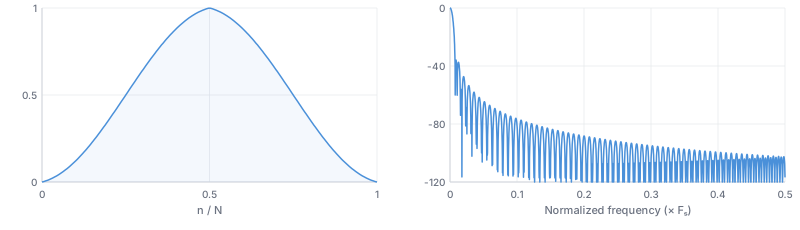
Bartlett-Hann hybrid. Balanced near/far sidelobe levels.10 -36 dB sidelobe
lanczos(i, N)$w(n) = \text{sinc}!\left(\frac{2n}{N-1} - 1\right)$
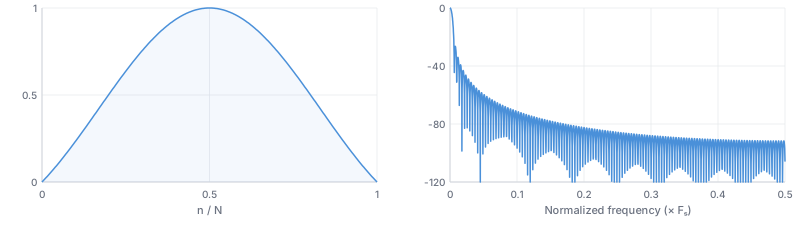
Sinc main lobe. Image resampling, interpolation (FFmpeg, ImageMagick).11 -26 dB sidelobe
parzen(i, N)$w(n) = 1 - 6a^2(1-a)$ for $|a| \le 0.5$, $w(n) = 2(1-a)^3$ for $|a| > 0.5$, $a = |(2n-N+1)/(N-1)|$
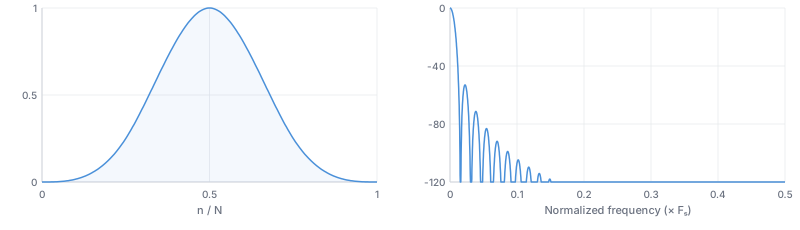
4th-order B-spline. Always-positive spectrum. Kernel density estimation.12 -53 dB sidelobe · -24 dB/oct rolloff
bohman(i, N)$w(n) = (1-|a|)\cos(\pi|a|) + \frac{\sin(\pi|a|)}{\pi}$, $a = \frac{2n-N+1}{N-1}$
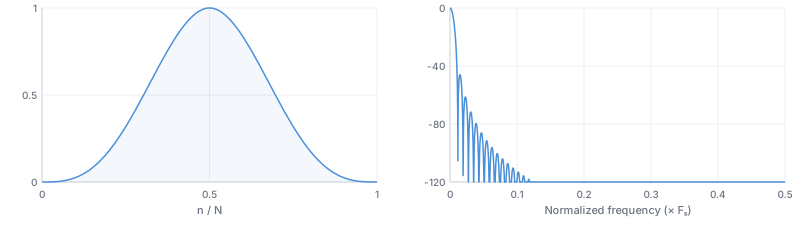
Autocorrelation of cosine window. Fast sidelobe decay, spectral estimation. -46 dB sidelobe · -24 dB/oct rolloff
kaiser(i, N, beta)beta: shape — 0 = rectangular, 5.4 = Hamming, 8.6 (default) = Blackman.
$w(n) = \frac{I_0!\left(\beta\sqrt{1 - \left(\frac{2n-N+1}{N-1}\right)^2}\right)}{I_0(\beta)}$
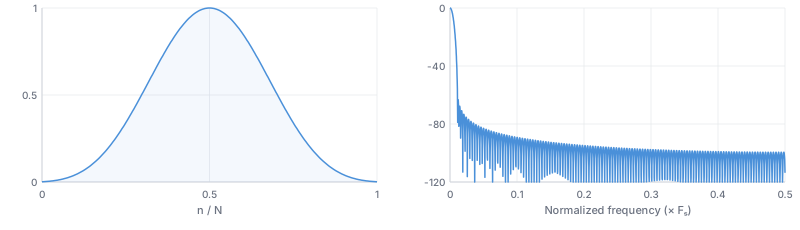
Near-optimal DPSS approximation via Bessel I₀. The standard parameterized window for FIR filter design.13
gaussian(i, N, sigma)sigma: width, default 0.4.
$w(n) = \exp!\left[-\frac{1}{2}\left(\frac{2n-N+1}{\sigma(N-1)}\right)^2\right]$
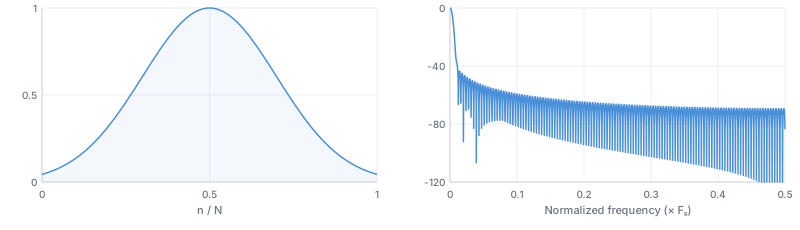
Gaussian bell, minimum time-bandwidth product. STFT/Gabor transform, frequency estimation via parabolic interpolation.14
generalizedNormal(i, N, sigma, p)sigma: width (default 0.4), p: shape — 2 = Gaussian, large = rectangular.
$w(n) = \exp!\left[-\frac{1}{2}\left|\frac{2n-N+1}{\sigma(N-1)}\right|^p\right]$
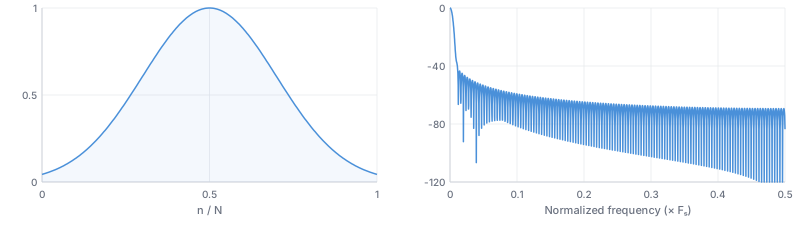
Continuous family between Gaussian and rectangular. Adjustable time-frequency tradeoff.
tukey(i, N, alpha)alpha: taper fraction — 0 = rectangular, 0.5 (default), 1 = Hann.
$w(n) = \tfrac{1}{2}[1+\cos(\pi(n/(\alpha(N!-!1)/2)-1))]$ in tapered edges, $w(n) = 1$ in flat center.
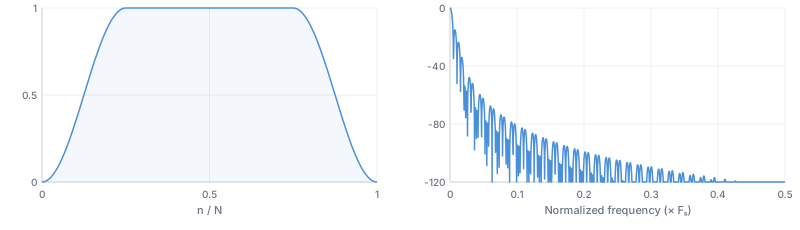
Flat center with cosine-tapered edges. Preserves signal amplitude while tapering. Vibration analysis, LIGO.
planckTaper(i, N, epsilon)epsilon: taper fraction, default 0.1.
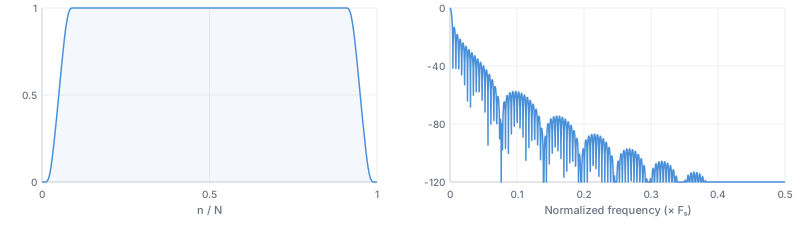
C∞-smooth bump function (infinitely differentiable). Gravitational wave analysis (LIGO/Virgo).15
powerOfSine(i, N, alpha)alpha: exponent — 0 = rectangular, 1 = cosine, 2 (default) = Hann.
$w(n) = \sin^\alpha!\left(\frac{\pi n}{N-1}\right)$
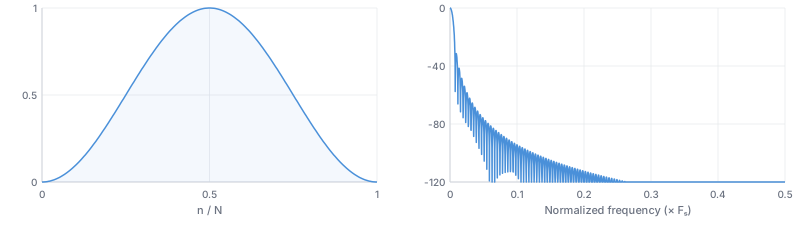
$\sin^\alpha$ family. Codec design, parameterized spectral analysis.
exponential(i, N, tau)tau: time constant, default 1.
$w(n) = \exp!\left(\frac{-|2n-N+1|}{\tau(N-1)}\right)$
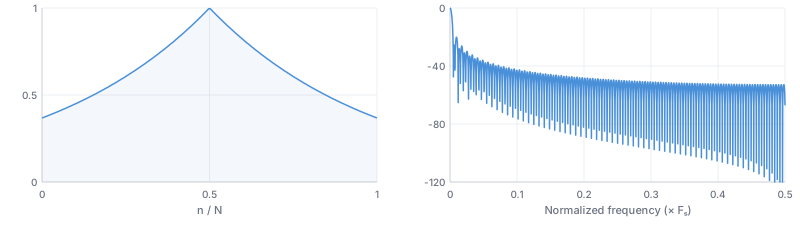
Exponential decay from center. Modal analysis, impact testing.7
hannPoisson(i, N, alpha)alpha: decay, default 2. At α ≥ 2 the transform has no sidelobes.
$w(n) = \frac{1}{2}\left(1-\cos\frac{2\pi n}{N!-!1}\right)\exp!\left(\frac{-\alpha|2n!-!N!+!1|}{N-1}\right)$
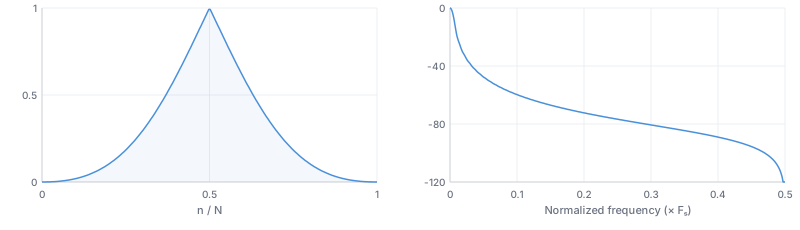
Hann × exponential. Unique no-sidelobe property enables frequency estimators using convex optimization.
cauchy(i, N, alpha)alpha: width, default 3.
$w(n) = \frac{1}{1+\left(\frac{\alpha(2n-N+1)}{N-1}\right)^2}$
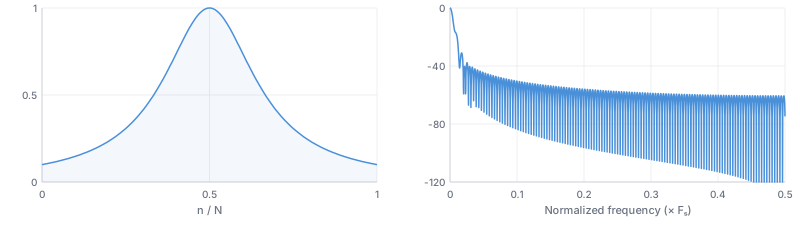
Lorentzian shape. Matches spectral line shapes in spectroscopy.7
rifeVincent(i, N, order)order: 1 (default) = Hann, 2, 3. Throws for other values.
$w(n) = \frac{1}{Z}\sum_{k=0}^{K}(-1)^k a_k\cos\frac{2\pi kn}{N-1}$
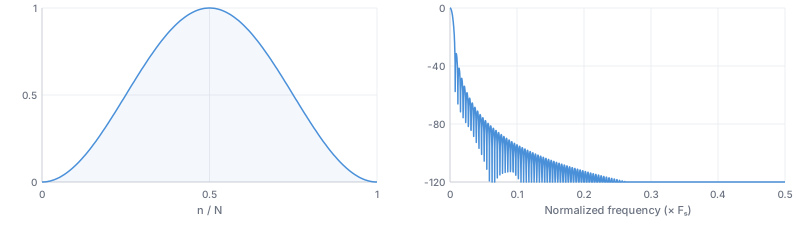
Class I cosine-sum optimized for sidelobe fall-off. Power grid harmonic analysis, interpolated DFT.16
confinedGaussian(i, N, sigmaT)sigmaT: temporal width, default 0.1.
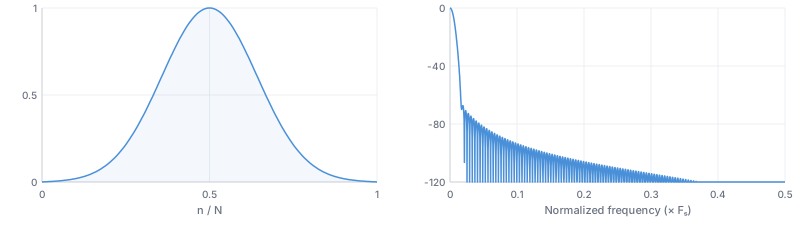
Optimal RMS time-frequency bandwidth. Time-frequency analysis, audio coding.17
Compute the full window on first call, cache the result. Recomputed when parameters change.
dolphChebyshev(i, N, dB)dB: sidelobe attenuation, default 100.
$W(k) = (-1)^k T_{N-1}!\left(\beta\cos\frac{\pi k}{N}\right)$, $w = \text{IDFT}(W)$
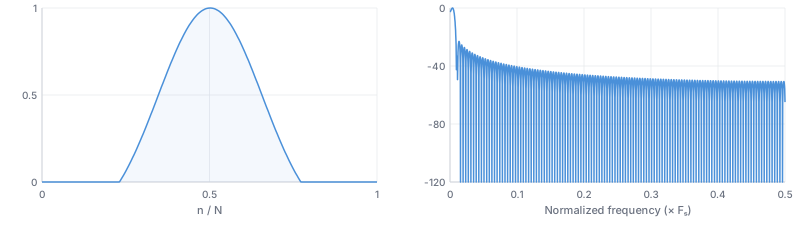
Optimal: narrowest main lobe for given equiripple sidelobe level. Antenna design, radar.18
taylor(i, N, nbar, sll)nbar: constant-level sidelobes (default 4), sll: level in dB (default 30).
$w(n) = 1 + 2\sum_{m=1}^{\bar{n}-1} F_m \cos\frac{2\pi m(n-(N!-!1)/2)}{N}$
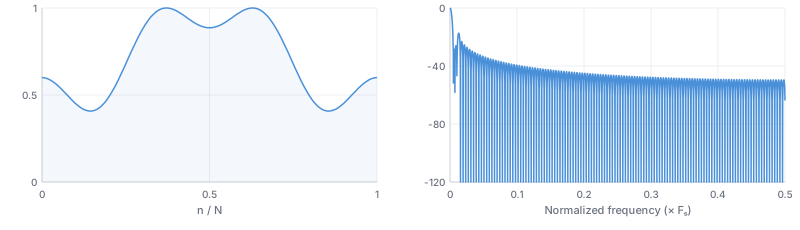
Monotonically decreasing sidelobes. The radar community standard for SAR image formation.19
kaiserBesselDerived(i, N, beta)beta: shape, default 8.6. N must be even.
$w(n) = \sqrt{\frac{\sum_{j=0}^{n} K(j)}{\sum_{j=0}^{N/2} K(j)}}$, $K(j) = I_0!\left(\beta\sqrt{1-\left(\frac{2j-N/2}{N/2}\right)^2}\right)$
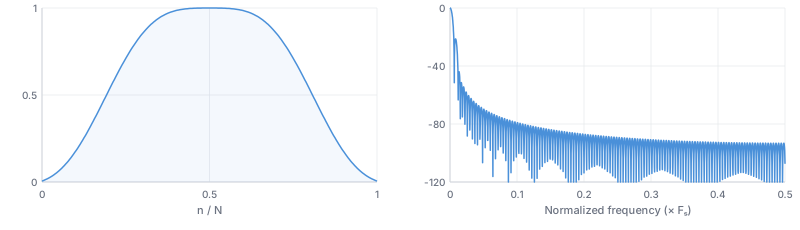
Princen-Bradley condition for perfect MDCT reconstruction. AAC, Vorbis, Opus audio codecs.6
dpss(i, N, W)W: half-bandwidth [0, 0.5], default 0.1.
$\mathbf{T}\mathbf{v} = \lambda\mathbf{v}$, $T_{jk} = \frac{\sin 2\pi W(j-k)}{\pi(j-k)}$
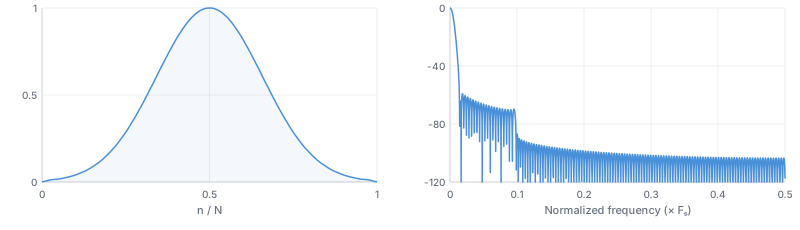
Dominant eigenvector of sinc Toeplitz matrix — provably optimal energy concentration. Also called Slepian window. Multitaper spectral estimation, neuroscience, climate science.20
ultraspherical(i, N, mu, xmu)mu: 0 = Dolph-Chebyshev, 1 (default) = Saramaki. xmu: sidelobe control (default 1).
$W(k) = C_n^\mu!\left(x_\mu\cos\frac{\pi k}{N}\right)$, $w = \text{IDFT}(W)$
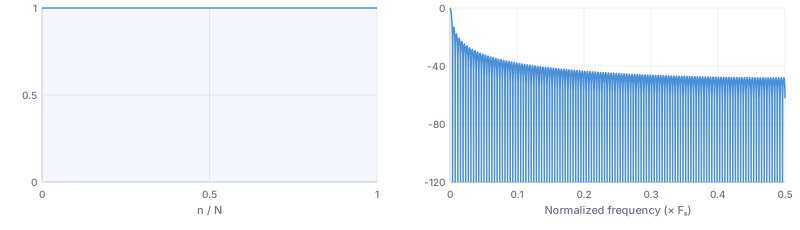
Gegenbauer polynomial window. Independent control of sidelobe level and taper rate. Antenna design, beamforming.21
Every window trades frequency resolution (narrow main lobe), spectral leakage (low sidelobes), and amplitude accuracy (flat top). No single window wins all three.
Three functions for quantitative window comparison:
import { hann, enbw, scallopLoss, cola } from 'window-function'

enbw(hann, 1024)                 // 1.5 — noise bandwidth (bins)
scallopLoss(hann, 1024)          // 1.42 — worst-case amplitude error (dB)
cola(hann, 1024, 512)            // 0 — perfect STFT reconstruction
enbw(fn, N, ...params) — equivalent noise bandwidth in frequency bins. Rectangular = 1.0, Hann = 1.5, Blackman-Harris = 2.0. Lower = less noise.scallopLoss(fn, N, ...params) — worst-case amplitude error in dB between DFT bins. Rectangular = 3.92, Hann = 1.42, flat-top ≈ 0.cola(fn, N, hop, ...params) — COLA deviation. 0 = perfect STFT reconstruction at given hop size.M.S. Bartlett, "Periodogram Analysis and Continuous Spectra," Biometrika 37, 1950. ↩
P.D. Welch, "The Use of FFT for Estimation of Power Spectra," IEEE Trans. Audio Electroacoustics AU-15, 1967. ↩
J. Connes, "Recherches sur la spectroscopie par transformation de Fourier," Revue d'Optique 40, 1961. ↩
R.B. Blackman & J.W. Tukey, The Measurement of Power Spectra, Dover, 1958. ↩ ↩2
R.W. Hamming, Digital Filters, Prentice-Hall, 1977. ↩
J.P. Princen, A.W. Johnson & A.B. Bradley, "Subband/Transform Coding Using Filter Bank Designs Based on TDAC," ICASSP, 1987. ↩ ↩2
F.J. Harris, "On the Use of Windows for Harmonic Analysis with the DFT," Proc. IEEE 66, 1978. ↩ ↩2 ↩3 ↩4
A.H. Nuttall, "Some Windows with Very Good Sidelobe Behavior," IEEE Trans. ASSP 29, 1981. ↩ ↩2
G. Heinzel, A. Rudiger & R. Schilling, "Spectrum and Spectral Density Estimation by the DFT," Max Planck Institute, 2002. ↩
Y.H. Ha & J.A. Pearce, "A New Window and Comparison to Standard Windows," IEEE Trans. ASSP, 1989. ↩
C.E. Duchon, "Lanczos Filtering in One and Two Dimensions," J. Applied Meteorology 18, 1979. ↩
E. Parzen, "Mathematical Considerations in the Estimation of Spectra," Technometrics 3, 1961. ↩
J.F. Kaiser, "Nonrecursive Digital Filter Design Using the Sinh Window Function," IEEE Int. Symp. Circuits and Systems, 1974. ↩
D. Gabor, "Theory of Communication," J. IEE 93, 1946. ↩
D.J.A. McKechan et al., "A Tapering Window for Time-Domain Templates," Class. Quantum Grav. 27, 2010. ↩
D.C. Rife & G.A. Vincent, "Use of the DFT in Measurement of Frequencies and Levels of Tones," Bell Syst. Tech. J. 49, 1970. ↩
S. Starosielec & D. Hagemeier, "Discrete-Time Windows with Minimal RMS Bandwidth," Signal Processing 102, 2014. ↩
C.L. Dolph, "A Current Distribution for Broadside Arrays," Proc. IRE 34, 1946. ↩
T.T. Taylor, "Design of Line-Source Antennas," IRE Trans. Antennas Propag. AP-4, 1955. ↩
D. Slepian, "Prolate Spheroidal Wave Functions — V," Bell Syst. Tech. J. 57, 1978. ↩
R.L. Streit, "A Two-Parameter Family of Weights for Nonrecursive Digital Filters and Antennas," IEEE Trans. ASSP 32, 1984. ↩